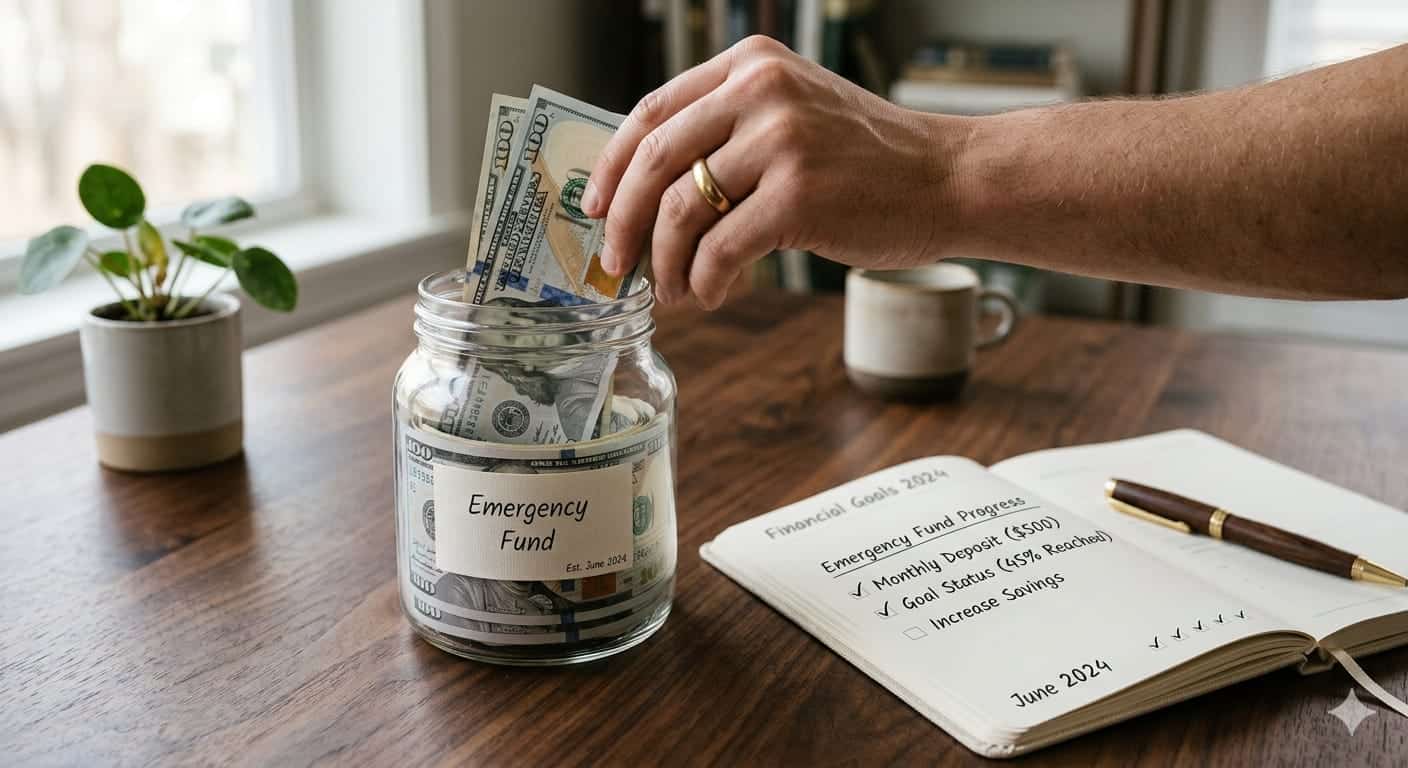
I “started” an emergency fund four times before I actually built one.
Same story each time. Open a savings account. Transfer some money in. Feel good about it for about two weeks. Then life happens — a bill, a purchase I’d been putting off, a weekend that cost more than expected — and the money quietly migrates back to checking. I’d tell myself I’d restart next month. I usually didn’t.
What finally worked wasn’t a different mindset or better discipline. It was a different system — one that made the money genuinely difficult to touch without removing my ability to access it in an actual emergency.
The emergency fund challenge I’m going to walk you through is the version that worked for me after the previous four didn’t. Not because it’s complicated, but because it removes most of the decisions that allowed me to fail the other times.
Here’s the thing nobody mentions about emergency funds: building financial security in your 20s doesn’t require a high income or perfect discipline. It requires removing the friction from the right behaviours and adding friction to the wrong ones. The emergency fund challenge does both.
SECTION 1: Why 42% of Americans Have No Emergency Fund (It’s Not What You Think)
Here’s a number worth sitting with a U.S. News & World Report survey found that 42% of Americans have no emergency fund at all. And 40% couldn’t cover a $1,000 emergency expense with cash or savings.
The instinct is to call this a discipline problem. People spend too much. They don’t prioritize saving. They need to cut the lattes.
That’s not what’s actually happening for most people.
What’s actually happening: nobody built a system for them. And systems matter infinitely more than intentions when it comes to money.
Think about how saving without a system works: you get paid, you spend what feels normal, you save what’s left. What’s left is usually very little — not because you’re irresponsible, but because human brains treat available money as spendable money. If your checking account shows $1,400, your brain perceives $1,400 as your resource. The fact that $300 of that was supposed to be “savings” is a mental category your brain doesn’t naturally enforce.
The emergency fund challenge fixes this at the system level. The money doesn’t stay in your checking account waiting for you to save it. It moves automatically, before you interact with it, to a place that’s slightly harder to touch. That’s the entire mechanism. It sounds simple because it is.
SECTION 2: The Emergency Fund Challenge — Pick Your Timeline
Not everyone is starting from the same place. The challenge has three versions:
The 90-Day Challenge — $333/Month
This is the version I’d recommend for most people. Aggressive enough to feel real, realistic enough to actually finish.
$333/month = $83/week = $12 per day. That math makes it feel smaller than “save $333 this month” does.
Where to find $333/month without feeling like you’re cutting everything:
Start with your subscriptions. The average person is paying for subscriptions they’ve forgotten about — streaming services they don’t watch, apps they stopped using, annual renewals they don’t remember signing up for. When I did the 30-day spending challenge, I found $67/month in subscriptions I couldn’t name two weeks after the audit. That’s nearly 20% of the $333 target, from things that were providing zero value.
The remaining amount comes from small intentional cuts — one fewer food delivery per week ($15-20 saved), one fewer coffee shop visit per week ($5-7 saved), cooking at home two more nights per week than usual ($30-40 saved). You’re at $110-130 saved through minor adjustments that most people don’t genuinely notice after the first week.
The rest — roughly $200 — comes from the automatic transfer we’ll set up in Section 3. You don’t find the money. The system moves it before you have a chance to spend it.
Timeline to $1,000: 90 days
The 60-Day Challenge — $500/Month
More aggressive. Requires one month of genuinely cutting discretionary spending and probably one injection of extra cash — selling unused items, picking up a side gig, delivering for one weekend.
Most people have $100-300 of stuff sitting unused that could become cash in 48 hours on Facebook Marketplace or OfferUp. One weekend of listing things is often the difference between a 90-day timeline and a 60-day one.
Timeline to $1,000: 60 days
The 30-Day Sprint
I’ve done this. It works. It’s not comfortable.
The 30-day sprint requires simultaneously cutting almost all discretionary spending, selling some things, and often picking up extra income for the month. It’s a short-term sacrifice that most people can sustain for 30 days when they remind themselves it’s only 30 days.
The psychological payoff of having $1,000 in savings after one month is real. It changes how you feel about money in a way that’s hard to explain until you experience it.
Timeline to $1,000: 30 days.
SECTION 3: The System That Makes the Challenge Actually Work
Here’s where most emergency fund attempts fail: the money stays in your checking account, earmarked mentally as “savings,” and it doesn’t stay there.
The fix is two steps:
Step 1: Open a separate high-yield savings account
Not at your current bank. At an online bank — specifically one that takes 1-2 business days to transfer money out of. That slight delay is intentional. It’s enough friction to stop impulse withdrawals without preventing you from accessing the money in a genuine emergency.
In 2026, the best options are:
- Ally Bank — consistently strong APY, no fees, excellent mobile app, “buckets” feature lets you label savings by goal
- Marcus by Goldman Sachs — simple, clean, competitive APY, no minimums
- SoFi — 4.6% APY with direct deposit, additional member benefits
At 4.5-5% APY, your $1,000 earns $45-50 in interest annually. Not life-changing on $1,000, but the rate matters more as the balance grows toward 3-6 months of expenses.
Step 2: Set up an automatic transfer — amount based on your chosen timeline — to happen the day your paycheck hits
Not two days after. Not when you remember. The day it hits.
Before you log in and see your full balance. Before your brain registers the full amount as available. The money moves, and your checking account shows a lower number that you adapt to within about two weeks.
That’s the system. It’s not sophisticated. It works because it removes the decision.
SECTION 4: What Counts as an Emergency (Honest Version)
You’ll need clarity on this before you have an emergency, not during one.
During a financial crisis, everything feels like an emergency. The sale that ends today. The thing that’s on discount for the next 48 hours. The expense you’ve been putting off that suddenly feels urgent. Your brain in a spending moment is not a reliable judge of whether something qualifies as an emergency.
These are emergencies:
- Car repair needed to get to work or get kids to school
- Medical expense that affects your health or safety
- Essential appliance failure — the refrigerator died, the heat stopped working in winter
- Unexpected job loss — covering rent and groceries while you sort it out
- Urgent home repair that affects habitability
These are not emergencies:
- A good deal on something you want
- An expense you knew was coming but didn’t plan for
- Replacing something that still works but is old
- Any purchase that’s primarily about want, even if it feels urgent
The test I use: if this situation didn’t exist, would my ability to live, work, and stay healthy be meaningfully compromised? If the honest answer is yes, it’s an emergency. If the honest answer is “sort of” or “eventually,” it’s not — and there’s another way to handle it that doesn’t undo months of building.
SECTION 5: After $1,000 — What Comes Next
Reaching $1,000 is the beginning, not the finish line.
After the first milestone, the same system continues — you just don’t stop. The automatic transfer keeps running. The emergency fund keeps growing toward the real target: 3-6 months of essential living expenses.
For most people that’s somewhere between $6,000 and $18,000 depending on income and lifestyle. It sounds like a lot. It becomes a series of $1,000 milestones — each one building on the momentum of the last.
The first $1,000 is always the hardest. After that, the habit is already built. The account already exists. The automation is already running. You’ve already proven to yourself that you can do it.
Everything that comes after is just the same system running longer.
FAQ
How quickly can I realistically complete the emergency fund challenge? Most people in the 90-day version reach $1,000 within 3 months through automatic transfers combined with minor spending adjustments. The 30-day sprint is possible for people willing to temporarily cut most discretionary spending and sell unused items. The timeline matters less than starting — every week delayed is a week without the financial cushion.
Where should my emergency fund actually live? In a high-yield savings account at an online bank — separate from your everyday checking account. Ally, Marcus, and SoFi are the top options in 2026. The separation and the 1-2 day transfer delay reduce impulse withdrawals without preventing genuine emergency access.
Should I build an emergency fund or pay off debt first? Build $1,000 first — even before aggressively paying high-interest debt. Without a cash cushion, every unexpected expense goes onto a credit card, undoing your debt payoff progress. Think of the $1,000 as protecting your debt payoff strategy, not competing with it.
What if I can only save $25 or $50 a month? Start with whatever you can automate. $25/month gets you to $1,000 in 40 months — slower, but it builds the habit and the account. As income increases or expenses decrease, raise the transfer amount. The habit matters more than the starting amount.
What’s the difference between an emergency fund and regular savings? Emergency funds are specifically for unexpected expenses that threaten your financial stability — job loss, medical emergencies, essential repairs. Regular savings are for planned future expenses — vacations, purchases, goals. They should live in separate accounts so one doesn’t accidentally fund the other.
11 thoughts on “Emergency Fund Challenge: How I Finally Saved $1,000 (After Years of Failing)”