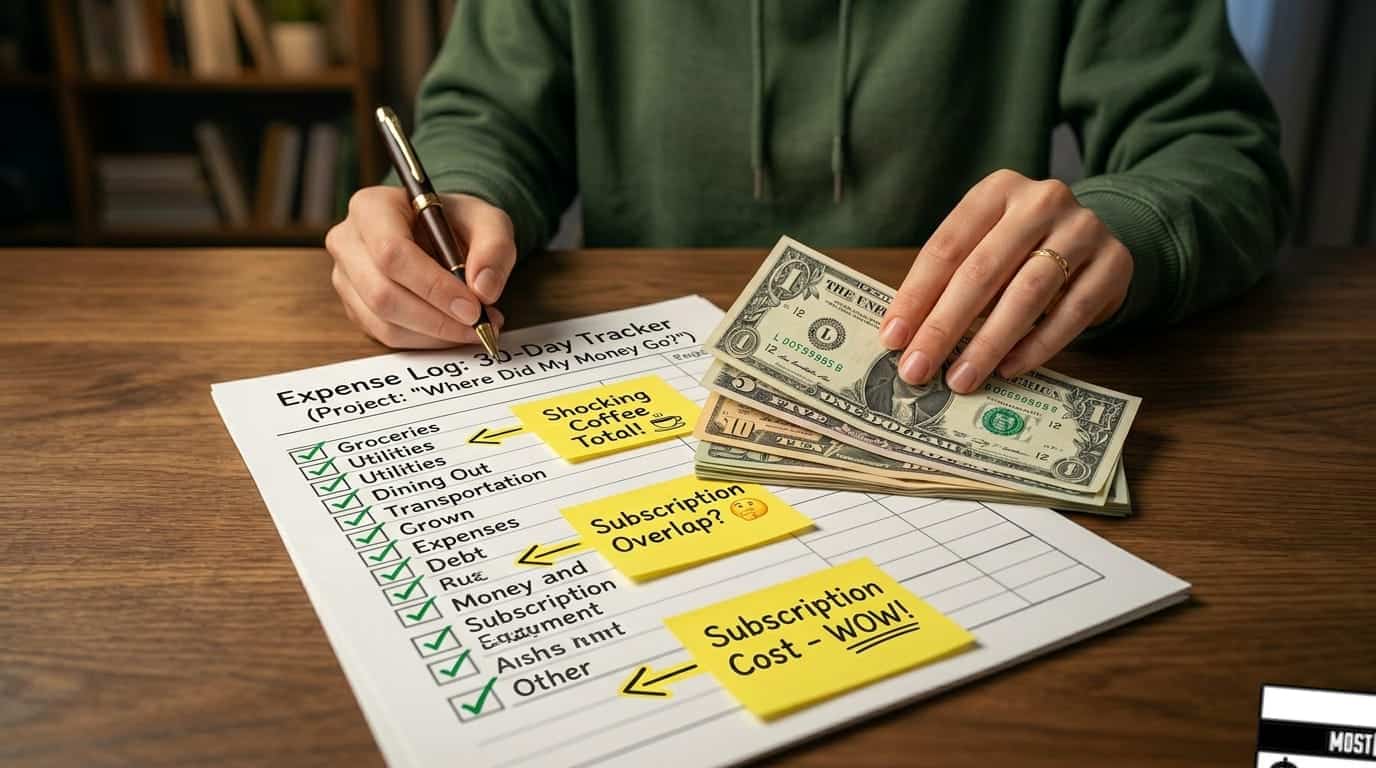
30-day spending challenge results!
I thought I knew where my money was going.
I was wrong. Embarrassingly wrong.
Thirty days ago I decided to track every single dollar I spent — not with a complicated spreadsheet, not with a financial advisor, just a notes app and brutal honesty. Every coffee. Every impulse Amazon purchase. Every “it’s only $4” decision that somehow added up to a number I wasn’t prepared to see.
The 30 day spending challenge results surprised me in ways I didn’t expect. Not just the total — though that was uncomfortable — but the patterns. The specific categories where money disappeared without ever feeling like a real decision. The habits I didn’t know I had.
If you’ve ever reached the end of a month and thought “where did it all go?” — this is for you.
SECTION 1: Why I Started Tracking in the First Place
It wasn’t a budgeting epiphany. It wasn’t some inspiring podcast moment.
It was a Tuesday afternoon when I opened my banking app to check my balance and found a number that didn’t match what I thought should be there. I’d been paid recently. I hadn’t done anything unusual. The money was just… less than it should have been.
That’s the thing about modern spending. It doesn’t feel like spending. It feels like small decisions. A subscription here. A food delivery there. A couple things from a cart that had been sitting half-full for a week. None of it feels significant in the moment. All of it adds up in ways that are genuinely hard to track mentally.
So I decided to track it manually for 30 days. Every transaction. Written down the same day it happened. No exceptions, no skipping the embarrassing ones.
Here’s what I found.
SECTION 2: The 30 Day Spending Challenge — Week by Week
Week 1: The Awareness Shock
The first week of any spending challenge is uncomfortable — not because you spend more than usual, but because you see clearly what “usual” actually looks like.
My week 1 breakdown:
- Groceries: $94
- Food delivery/restaurants: $67
- Subscriptions charged this week: $43
- Random purchases (household items, small Amazon orders): $38
- Transportation: $31
- Coffee/drinks: $22
Total week 1: $295
That food delivery number hit differently when I wrote it down. $67 in one week. Not because I had a big dinner out or anything memorable — just a few “I don’t feel like cooking” decisions that each felt like a $15-20 non-event.
The subscription number was also a surprise. $43 in a single week. Three different services auto-charged in the same 7-day window and I’d forgotten about two of them entirely.
The act of writing it down immediately changed my behavior. Not because I was trying to cut anything — just because awareness creates a slight pause before spending. That pause turned out to matter.
Week 2: The Patterns Emerge
Week 2 is where the 30 day spending challenge gets interesting. One week of data is just data. Two weeks of data starts showing patterns.
My patterns were not flattering.
The food delivery habit appeared again — lower this week ($41) but still there. Every Tuesday and Thursday evening, regardless of whether I was actually busy or just not feeling like cooking, I’d order something. It had become automatic. I’d never consciously decided to spend $80-140 a month on food delivery. It just happened, twice a week, without thinking.
I also noticed that my Amazon purchases clustered around specific times. Sunday evenings. Monday mornings. Times when I was slightly bored or slightly stressed. The purchases weren’t things I needed. They were things I’d looked at, added to my cart at some point, and eventually pulled the trigger on during low-attention moments.
Week 2 total: $241
Week 3: The Uncomfortable Middle
Week 3 of a 30 day spending challenge is where most people quit if they’re doing a no-spend version. The novelty is gone, the discomfort is real, and the finish line is still two weeks away.
I wasn’t doing a strict no-spend challenge — just tracking. But week 3 is still where the discomfort set in because by this point I’d seen enough patterns to feel genuinely uncomfortable about some of them.
I reduced food delivery to once that week. Not as a rule — just because seeing the pattern made me less automatic about it. I made a list before opening Amazon on Sunday evening and asked myself whether each item was something I’d actually use or something I was buying because I was bored at 9pm.
Week 3 total: $198 — my lowest week.
The $97 drop from week 1 wasn’t from dramatic lifestyle changes. It was entirely from awareness. Just knowing I’d write it down made me pause before spending in a way I never had before.
Week 4: The Final Count and What It Actually Meant
Week 4 brought a few larger expenses — a bill I’d forgotten was coming, a household item I’d been putting off. It pushed the final week up.
Week 4 total: $267
Full 30 day spending challenge results:
| Category | Total 30 days | Monthly “budget” I thought I had |
|---|---|---|
| Groceries | $312 | $300 |
| Food delivery/restaurants | $178 | $80 |
| Subscriptions | $127 | $60 |
| Random purchases | $143 | $50 |
| Transportation | $124 | $120 |
| Coffee/drinks | $71 | $40 |
| Household/bills | $98 | $100 |
| Total | $1,053 | $750 |
I was spending $303 more per month than I thought I was.
Not in one obvious category. Not through any single bad decision. Across multiple small categories where my mental budget was significantly lower than my actual behavior.
SECTION 3: What the 30 Day Challenge Actually Revealed
The Subscription Problem Is Real
$127 on subscriptions in a month I thought I was spending $60 on subscriptions.
When I listed every subscription I was paying for, I found 11 of them. Streaming services, a fitness app I’d used twice, cloud storage across two different platforms, a news site I’d subscribed to during an election and forgotten about, and three others I had to genuinely think about to remember what they were for.
I cancelled four immediately. That’s $38/month back — $456 annually — from things that provided essentially zero value to my daily life.
If you haven’t audited your subscriptions recently, this is worth doing before anything else. There’s a free tool called Rocket Money that does this automatically by scanning your transactions — I started using it after this challenge and it found two more, I’d missed. (If you want to see what it found, I covered the best money-saving apps in detail in my post on [saving $500 a month with free fintech apps] — the subscription audit section is worth reading.)
The “Small” Purchases Add Up Faster Than You Think
$143 on “random purchases” was the category that bothered me most.
Not because $143 is a catastrophic amount. Because I couldn’t name most of them two weeks later. They were purchases I’d forgotten about because they didn’t feel meaningful when I made them.
That’s the problem. Money spent on things you forget you bought is money that provided zero satisfaction. It’s not even the guilty pleasure of an expensive dinner you actually enjoyed. It’s just gone, with nothing to show for it.
Awareness Alone Reduced My Spending by 33% in Week 3
I didn’t go on a spending freeze. I didn’t cut anything specific. I just knew I’d be writing it down.
That awareness alone took me from $295 in week 1 to $198 in week 3.
There’s research behind why this works — the act of tracking spending increases what behavioral economists call “transaction pain.” When you have to consciously record a purchase, the psychological friction of spending increases slightly. That slight friction catches impulsive decisions before they happen.
The best budgeting advice isn’t “spend less.” It’s “know what you’re spending.” The behavior changes follow naturally from the awareness.
SECTION 4: How to Do Your Own 30 Day Spending Challenge
You don’t need an app. You don’t need a spreadsheet. You need one place where you record every purchase on the day it happens.
The simple version:
- Open Notes app on your phone
- Every time you spend money — anything, any amount — write it down with the category and amount
- At the end of each week, add it up by category
- Don’t judge it for the first two weeks. Just see it.
The slightly more powerful version: Use a free budgeting app like Copilot or YNAB’s free trial that automatically categorizes your transactions. Less manual work, same awareness effect, more accurate picture.
The one rule that matters: Don’t skip the embarrassing ones. The point isn’t to feel good about your spending. The point is to see it clearly. You can’t fix something you’re pretending isn’t there.
What to do with what you find: After 30 days, look at the gap between what you thought you were spending and what you actually spent. That gap — in whatever category it shows up — is your starting point. Not a reason for guilt. A starting point.
In my case, the gap was subscriptions ($67 more than expected) and food delivery ($98 more than expected). Those two categories alone accounted for $165/month of spending I hadn’t consciously decided to do.
$165/month is $1,980 a year. That’s a flight somewhere. That’s three months of an emergency fund. That’s the beginning of a Roth IRA contribution.
It was sitting in subscriptions I’d forgotten about and food delivery decisions I’d automated.
FAQ
What is a 30 day spending challenge? A 30 day spending challenge means tracking every dollar you spend for a full month — or in stricter versions, committing to spend only on necessities for 30 days. The tracking version is more sustainable for most people and produces similar awareness benefits without requiring dramatic lifestyle changes.
What are realistic 30 day spending challenge results? Most people who track spending for 30 days discover they’re spending 20-40% more than they estimated in at least one category. The most common surprises are subscriptions, food delivery, and small impulse purchases. Spending awareness alone typically reduces overall spending by 10-20% by week 3 without any intentional cutting.
Does a spending tracker actually help save money? Yes — behavioral research consistently shows that tracking spending reduces it. The mechanism is increased transaction awareness, which creates a slight pause before purchases that catches impulsive spending. People who track spending consistently save an average of $200-600 more per month than those who don’t.
What’s the easiest way to track spending for 30 days? The easiest sustainable method is a free budgeting app that automatically categorizes transactions — this removes the manual recording requirement while maintaining awareness. Apps like Copilot or the free version of Mint connect to your bank account and categorize spending automatically.
What should I do after a 30 day spending challenge? Identify the two or three categories where your actual spending most exceeded your expectations. Those are your highest-impact areas. Don’t try to change everything at once — address the biggest gap first. Most people find that subscriptions and food/dining are the fastest wins with the least lifestyle impact.
6 thoughts on “I Tracked Every Dollar I Spent for 30 Days — Here’s What Shocked Me Most”