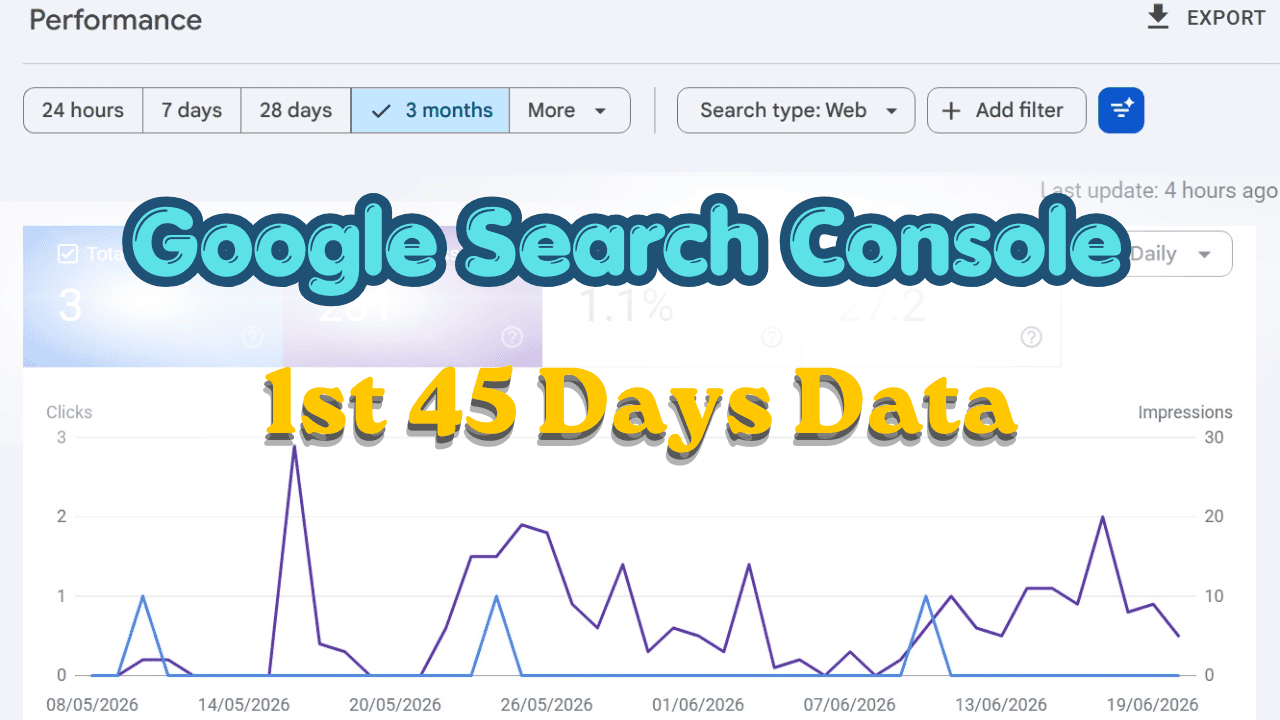
I’m going to show you something most bloggers never share.
Their actual numbers. Early. Before anything looks impressive.
VantageHustle launched 45 days ago. I’ve been tracking every data point in Google Search Console since day one — the impressions, the clicks, the countries, the exact search queries people typed to find this site. Not to brag. The numbers aren’t brag-worthy yet. But because the early data tells a story that most “how I built a successful blog” posts skip entirely — the part before it worked.
Here’s everything. Real screenshots. Real numbers. Honest interpretation of what it means.
The 45-Day Numbers: What Google Search Console Actually Showed
Let me put the headline numbers out first so you have context for everything that follows.
In 45 days of publishing, VantageHustle generated:
- 281 total impressions — meaning Google showed my content in search results 281 times
- 3 total clicks — meaning 3 people actually clicked through to the site from Google search, ” Google Search Console only tracks organic search traffic — one of several traffic sources VantageHustle receives. Pinterest, direct visits, and referral traffic appear in Google Analytics separately. The Search Console data represents search engine discovery progress specifically — not total site traffic.”
- 1.1% average CTR — click-through rate from impressions to actual visits
- 27.2 average position — meaning my content is ranking around page 2-3 of Google on average
Before I interpret those numbers, I want to say something important: I went into this knowing that 45 days is nothing in SEO terms. New sites don’t rank. Google doesn’t trust them yet. The data from the first 60-90 days is valuable not because it shows success — it usually doesn’t — but because it shows signals. What topics Google is starting to associate with your site. Which posts are getting impressions before they get clicks. Where in the world your content is being found.
With that framing — here’s what the data actually revealed.
The Impressions Graph: What 281 Impressions in 45 Days Actually Means
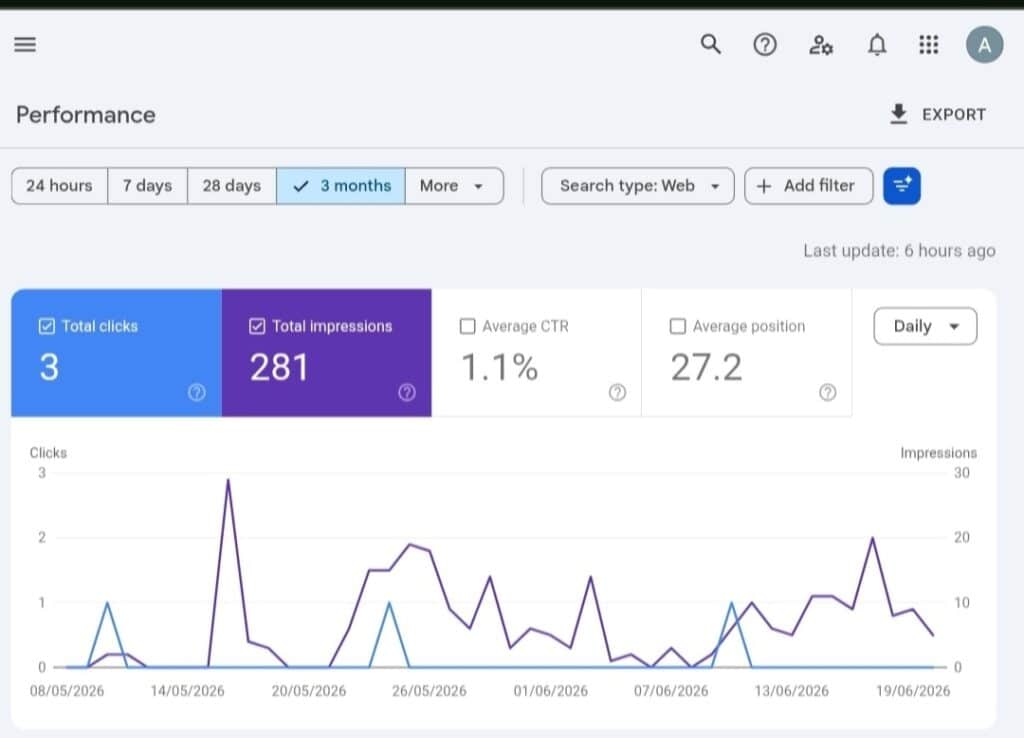
The impressions graph tells the story of a site going from completely invisible to gradually findable.
“One important context note: Google Search Console tracks organic search traffic only. It doesn’t show Pinterest visitors, direct traffic from people typing the URL, or referral traffic from other sites. The 267 impressions here represent VantageHustle’s search engine discovery progress specifically — the site receives traffic from multiple channels that appear in Google Analytics rather than Search Console.”
In the first two weeks — the first posts were published May 8-10 — impressions were essentially zero. Google hadn’t indexed the content yet, or had indexed it but wasn’t showing it to anyone.
Then something happened around May 15-16: a spike. That spike corresponds to when I requested indexing in Google Search Console for the first posts. Google crawled them, processed them, and started testing them in search results.
After that spike, impressions dropped back down — then gradually climbed throughout June to a more consistent baseline of 15-25 impressions per day by mid-June.
What this graph is telling me: Google is progressively discovering and testing VantageHustle content. The trend is upward. That’s the signal that matters at 45 days — not absolute numbers, but direction.
The 3 clicks on 281 impressions sounds discouraging until you understand why the CTR is low. Average position 27.2 means most of my content is appearing on page 2-3 of Google search results. Nobody clicks page 2. The path from “appearing” to “being clicked” runs directly through improving position — which happens through more content, more internal links, more time, and occasionally more backlinks.
The Countries Data: 31 Countries Found VantageHustle
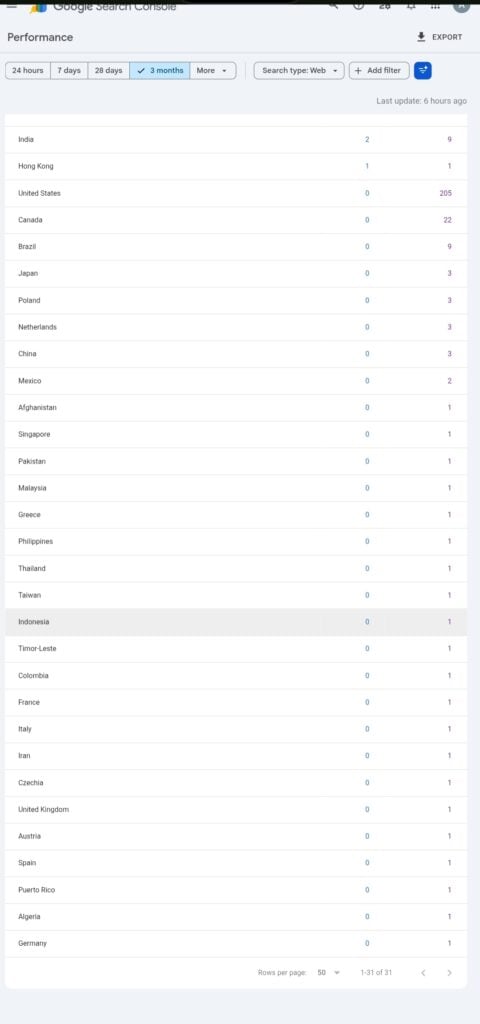
This is the data point that genuinely surprised me.
31 countries. In 45 days. From a site with zero marketing, zero backlinks, and no social media traffic driving people here.
That’s entirely organic — Google surfacing VantageHustle content to people searching relevant terms across the world.
The breakdown matters for understanding what’s working:
United States: 205 impressions, 0 clicks
This is the most important number on the page — and the most instructive. 205 US impressions means Google is showing VantageHustle content to American searchers 205 times. But zero clicks means those Americans are seeing the content in search results and not clicking it.
There are two explanations for this. The most likely: the content is appearing in positions 15-30, where click rates drop to under 1%. The second possibility: the title tags and meta descriptions aren’t compelling enough to earn the click even when the content appears.
Both are fixable. The first through continued publishing and authority building. The second through testing more click-worthy titles.
Canada: 22 impressions
Canada being the second-highest country makes sense — Canadian searchers use the same English-language Google, face similar personal finance situations to Americans, and search similar terms. The content is clearly relevant to them.
Brazil, Japan, Poland, Netherlands, Mexico, China — all showing impressions
This one I didn’t expect. Personal finance content written specifically for a US audience is showing up in searches across multiple countries. The topics — side hustles, money management, debt payoff — transcend geography even when the specifics are US-focused.
The Queries: What People Actually Searched to Find VantageHustle
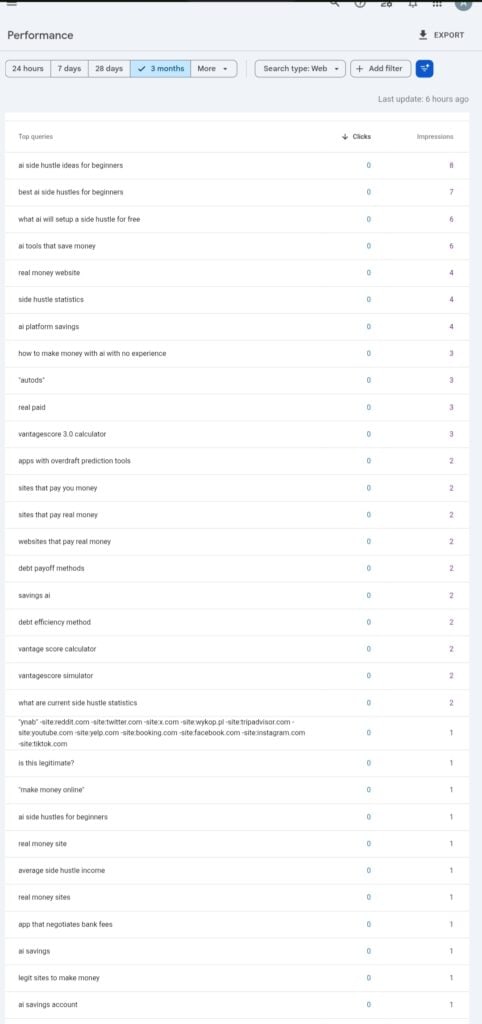
This is the most actionable data in Search Console — and the most honest feedback a new site can get.
Here are the top queries driving impressions to VantageHustle right now:
“ai side hustle ideas for beginners” — 8 impressions “best ai side hustles for beginners” — 7 impressions “what ai will setup a side hustle for free” — 6 impressions
Three of my top queries are variations of the same topic — AI side hustles for beginners. This tells me the post targeting that topic (AI side hustles for beginners) is the one Google is most actively testing in search results. 129 impressions on that single page confirms it.
[see all page’s data on below table]
“ai tools that save money” — 6 impressions “how to save money with ai tools” — shows up separately
The save money with AI tools post (how-to-save-money-with-ai-tools) has 61 impressions and 1 click — making it the highest-clicked page on the site. That single click represents a real person who found VantageHustle through Google search and visited. The first of many, hopefully.
“real money website” — 4 impressions “websites that pay real money” — 2 impressions
The websites that pay real money post is getting traction — 20 impressions and growing. The query variations showing up confirm the keyword targeting is working — Google understands what that post is about and is testing it for relevant searches.
“vantage score calculator” — 2 impressions
This one is interesting. Someone searched for a credit score calculator and found VantageHustle — despite the fact that I don’t have a calculator tool yet. This is direct user feedback: there’s demand for a financial calculator tool from people already finding this site. That’s going on the content roadmap.
“is this legitimate?” — 1 impression
Someone found VantageHustle and then searched whether it’s legitimate. I’m choosing to find that funny rather than discouraging. It also reinforces why trust signals — about page, real contact information, consistent publishing — matter.
The Pages Data: Which Content Is Actually Getting Found
The pages data shows which specific posts are generating impressions:
| Page | Clicks | Impressions |
|---|---|---|
| /ai-side-hustles-for-beginners/ | 0 | 129 |
| /how-to-save-money-with-ai-tools/ | 1 | 61 |
| /websites-that-pay-real-money/ | 0 | 20 |
| /how-to-make-money-with-ai/ | 0 | 16 |
| /side-hustle-income-report/ | 1 | 13 |
| Homepage | 1 | 12 |
| /debt-payoff-methods-that-work/ | 0 | 6 |
| /broke-in-your-20s-money-advice/ | 0 | 5 |
A few things jump out immediately.
The AI side hustles post has 129 impressions but zero clicks. That’s a title and meta description problem — the post is appearing in search results but not earning the click. I need to make the title more compelling for the specific queries driving those impressions.
The save money with AI tools post has the best ratio — 61 impressions, 1 click, and it’s consistently showing up for multiple relevant queries. That’s the template for what works.
The debt payoff and broke in your 20s posts are early — published more recently — and are already picking up impressions. Expect those numbers to grow as Google indexes them more thoroughly.
What I’d Do Differently in the First 45 Days
Honest reflection based on what the data is telling me:
I’d have focused earlier on click-worthy titles. 129 impressions with zero clicks on the AI side hustles post means the content is findable but the title isn’t earning the click. A/B testing different title approaches from the start would have converted some of those impressions to visits.
I’d have started Pinterest earlier and more consistently. All 281 impressions came from Google alone — zero traffic from social platforms in this data. Pinterest was always part of the plan but kept getting delayed. The posts that drive the most Google impressions are also the posts most naturally suited to Pinterest — AI side hustles, saving money, websites that pay. Traffic from Pinterest would have shown up in Google Analytics (not Search Console) and accelerated everything.
I’d have published faster in weeks 1-2. The impressions graph shows a clear pattern: more content published = more impressions. The first two weeks had fewer posts and correspondingly fewer impressions. The content compounding effect is real — each additional post is another entry point into search.
What the Data Says About Month 2
Based on 45 days of data, here’s what I expect to see change:
The AI side hustles post (129 impressions, 0 clicks) needs a title adjustment — the impressions are there, the clicks aren’t. That’s fixable.
The save money post (61 impressions, 1 click) needs more internal links pointing to it from newer posts — more internal authority should improve its position.
The newer posts — debt payoff, broke in your 20s, credit score improvement — are just starting to appear. Expect their impression counts to grow significantly over the next 30 days as Google indexes and tests them more thoroughly.
And the overall impression trend — climbing from near-zero in early May to 15-25 daily impressions in mid-June — suggests the trajectory is right even if the absolute numbers are modest.
281 impressions in 45 days from a brand new site with no backlinks and no social media traffic is, honestly, better than I expected at this stage. The clicks will follow the impressions — just on a delay that requires patience most bloggers don’t talk about.
The Real Lesson From 45 Days of Data
Starting a blog with honest results looks nothing like the success stories that get shared.
It looks like 281 impressions. 3 clicks. A graph that’s gradually trending upward instead of exploding. Countries you didn’t expect finding your content. Search queries revealing what readers actually want instead of what you assumed they’d search for.
The data doesn’t lie. And right now, the data is telling me VantageHustle is doing exactly what a 45-day-old site should do: getting found, getting indexed, getting tested by Google for relevance, and building the foundation that the next 45 days will compound on.
The interesting part is just starting.
FAQ
How long does it take for a new blog to get traffic from Google?? Most SEO experts suggest 3-6 months before meaningful organic traffic begins. The first 45-60 days typically produce impressions (Google testing your content in search results) without significant clicks. Positions improve over time as Google gains confidence in the site’s relevance and quality. The data from VantageHustle’s first 45 days reflects this pattern exactly.
What is a good number of impressions for a new blog?? There’s no universal benchmark, but 200-500 impressions in the first 45 days from a brand new site with no backlinks suggests Google is actively indexing and testing the content. The more important metric is the trend — impressions should be increasing week over week, which VantageHustle’s data confirms.
Why does my blog get impressions but no clicks?? Impressions without clicks almost always indicate one of two things: the content is ranking in positions 10-30 where click rates are very low (under 2%), or the title and meta description aren’t compelling enough to earn the click when the content does appear. Both are addressable — position improves with time and content authority; CTR improves with better title optimization.
Is Search Console data accurate for new blogs?? Search Console data has a 2-3 day delay and shows data from when Google first started indexing your site. For new blogs, the data underrepresents actual impressions in the first few weeks as Google catches up with indexing. The data becomes increasingly accurate and useful after the first 30-45 days.
How many blog posts do you need before Google starts ranking you?? There’s no magic number, but more content gives Google more to work with — more entry points into search, more internal linking opportunities, and more signals about what topics your site covers. The VantageHustle data suggests Google starts actively testing content around the time of the first 5-10 quality posts.